On This Page
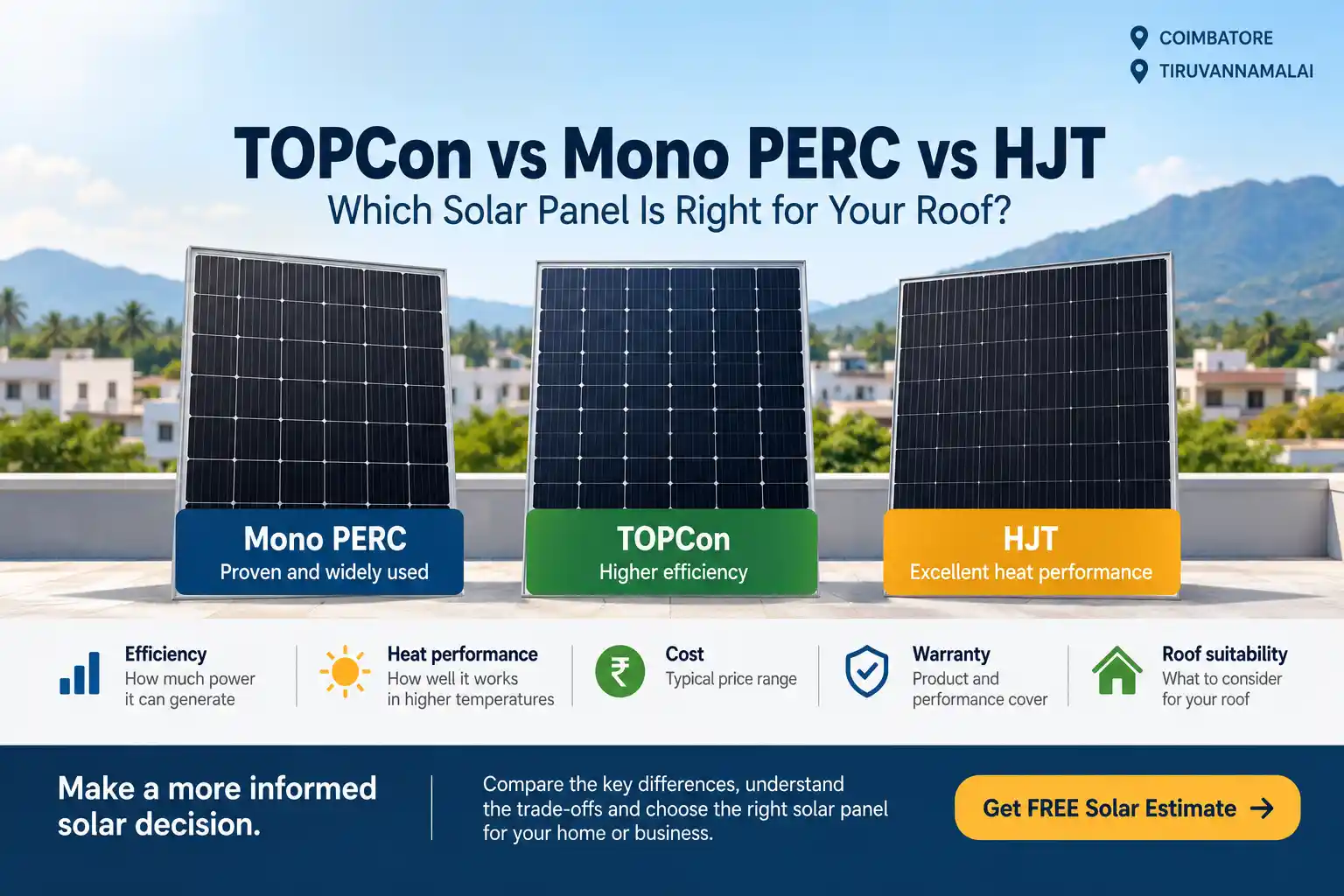
Planning to install rooftop solar? You may have come across terms like Mono PERC, TOPCon and HJT while comparing solar panel quotations.
One installer might recommend TOPCon panels. Another might offer Mono PERC at a different price. Someone else might suggest HJT because it is a newer technology.
Naturally, this raises a question: Which solar panel is actually better?
The simple answer is that TOPCon and HJT can offer certain advantages over conventional Mono PERC panels, but the right choice depends on your roof, budget and the actual panels being offered.
A newer technology does not automatically mean a better deal.
Let's understand the differences without getting lost in technical details.
1. TOPCon vs Mono PERC vs HJT: A Quick Comparison
All three technologies do the same basic job: they convert sunlight into electricity.
The difference is in how their solar cells are designed to capture energy and reduce losses.
| Feature | Mono PERC | TOPCon | HJT |
|---|---|---|---|
| Technology | Established | Newer | Newer |
| Solar panel efficiency | Generally lower than leading newer designs | Often higher | Often higher |
| Performance in heat | Depends on the model | Many models perform better | Many models have favourable heat performance |
| Bifacial options | Available | Available | Available |
| Main consideration | Overall value | Efficiency and cost | Performance and cost |
| Best for | Buyers with a suitable, competitively priced proposal | Buyers who benefit from its model-specific advantages | Buyers who can justify its model-specific benefits |
This table describes general trends, not guaranteed differences. Actual performance varies between manufacturers and panel models.
The important point: Instead of choosing based on the technology name, compare the specifications of the actual solar panels in your quotation.
2. What Are Mono PERC Solar Panels?
Mono PERC is an established solar panel technology.
It uses a special layer within the solar cell to reduce energy losses, helping the panel convert more sunlight into electricity.
Mono PERC panels have been widely used in residential and commercial solar installations.
Why consider Mono PERC?
A good Mono PERC panel can still be a sensible choice, especially when it is offered at a competitive price and meets the requirements of your installation.
Its advantages include:
- Established technology with many product options.
- Availability in different panel sizes.
- Potentially good value when roof space is sufficient.
- Options with different performance and warranty specifications.
What is the drawback?
Some newer TOPCon and HJT panels can offer better efficiency and temperature performance.
This means they may produce more power from the same panel area under comparable conditions.
However, the difference depends on the actual models.
Our advice: Don't reject Mono PERC simply because it is an older technology. Check what the panel offers and whether the complete installation is good value for money.
3. What Are TOPCon Solar Panels?
TOPCon stands for Tunnel Oxide Passivated Contact.
You don't need to remember the full name. What matters is that TOPCon uses an improved solar-cell design to reduce energy losses.
This allows manufacturers to make highly efficient solar panels.
Why do people choose TOPCon?
Good efficiency: Many TOPCon panels can produce more rated power from the same panel area than conventional Mono PERC alternatives.
Better temperature performance: Some TOPCon panels lose less power as their temperature increases.
Different panel options: TOPCon technology is available in products designed for residential and commercial rooftops.
These advantages can make TOPCon attractive when roof space is limited or when the particular model offers better overall value.
Is TOPCon always better?
No.
A TOPCon panel with poor specifications or unsuitable installation support is not automatically a better purchase than a well-specified Mono PERC panel.
You still need to compare the manufacturer, model, warranty, total installation price and suitability for your roof.
Our advice: TOPCon is worth considering, but ask the installer to explain what benefit the specific panel will offer for your installation.
4. What Are HJT Solar Panels?
HJT stands for Heterojunction Technology.
It uses a different solar-cell design that helps reduce certain energy losses.
HJT panels can offer high efficiency and favourable temperature performance.
Why consider HJT?
One potential advantage is how some HJT panels perform as their temperature rises.
All else being equal, a panel with a better temperature coefficient loses less of its rated power when it gets hotter.
Some HJT products also offer high efficiency and attractive long-term performance specifications.
Should everyone choose HJT?
Not necessarily.
An HJT panel may have excellent technical specifications, but that does not automatically justify paying more for it.
Before deciding, check:
- The exact panel model.
- Its efficiency and temperature performance.
- The complete installed price.
- Whether it suits your roof.
- Warranty terms and service arrangements.
- Local availability and applicable compliance requirements.
Our advice: Choose HJT when its benefits are meaningful for your installation and justify the price—not simply because it is a newer technology.
5. Which Solar Panel Performs Better in Tamil Nadu's Heat?
This is a useful question for homeowners and businesses in places such as Coimbatore and Tiruvannamalai.
Solar panels need sunlight to produce electricity. However, their electrical performance is also affected by heat.
A panel can become considerably hotter than the surrounding air, particularly when exposed to strong sunlight.
As the temperature of a typical crystalline-silicon panel rises, its maximum power output generally decreases.
What is a temperature coefficient?
Solar panel datasheets contain a specification called the temperature coefficient.
Put simply, it tells you how much the panel's rated power changes as its temperature increases.
A less negative power temperature coefficient generally means a smaller reduction in power when the panel gets hotter.
For example, compare these specifications:
| Example panel | Published power temperature coefficient |
|---|---|
| Waaree Ahnay Mono PERC | −0.34%/°C |
| Trina Vertex S+ Shield TOPCon | −0.29%/°C |
| REC Alpha Pure-R HJT | −0.24%/°C |
These figures come from specific manufacturer datasheets. They are examples, not average values for all Mono PERC, TOPCon or HJT panels.
In this comparison, the REC example has the smallest temperature-related reduction in rated power for the same rise in cell temperature.
But there is an important catch.
This does not mean the REC panel will generate the most electricity over an entire year.
Annual generation also depends on panel wattage, roof direction, shading, ventilation, weather and the complete system design.
The three examples also have different sizes and ratings, so they are not a direct like-for-like comparison.
These products are shown only to explain how specifications differ. They are not confirmed Scaler Solar offerings or verified Indian subsidy-eligible products. The cited REC model is manufactured in Singapore and should not be treated as eligible for PM Surya Ghar.
What should you do?
Ask your installer to explain how the selected panel is expected to perform on your roof, rather than assuming one technology will always produce more electricity.
6. Does a Higher-Wattage Solar Panel Mean Better Performance?
Not always.
Imagine you are comparing two panels:
- Panel A: 550 watts
- Panel B: 470 watts
At first glance, you might assume the 550 W panel is automatically better.
But there is something else to consider.
The 550 W panel might simply be physically larger.
Solar panel wattage and solar panel efficiency are related, but they are not the same thing.
What is solar panel efficiency?
Efficiency tells you how effectively a panel converts the sunlight falling on its surface into electricity under standard test conditions.
A more efficient panel can produce more rated power from the same panel area.
This can be particularly useful when roof space is limited.
A real manufacturer example
Published specifications for the three models discussed earlier show:
| Panel example | Rated power | Module efficiency |
|---|---|---|
| Waaree Ahnay Mono PERC | 550 W | 21.36% |
| Trina Vertex S+ Shield TOPCon | 470 W | 23.5% |
| REC Alpha Pure-R HJT | 430 W | 22.3% |
Notice something interesting?
The 550 W panel has the lowest efficiency of the three examples.
That doesn't mean it is a bad panel. It means the panels have different sizes and designs.
Similarly, the TOPCon example is more efficient than the HJT example. That doesn't mean every TOPCon panel is more efficient than every HJT panel.
The examples use manufacturer documentation for different product families and are not a controlled performance comparison. Their availability, suitability and scheme eligibility for Scaler Solar installations have not been established.
What matters for your roof?
The real question is not simply how many watts each panel produces.
It is:
How much suitable solar capacity can be safely installed in the usable area of my roof?
Your installer should consider the roof layout, shading, panel dimensions and installation requirements before recommending a system.
7. Is It Worth Paying More for TOPCon or HJT?
This is where the buying decision becomes practical.
Newer technology may provide benefits, but those benefits should be worth the additional cost, if any.
Consider three situations.
Situation 1: You have limited roof space
Suppose a significant portion of your roof is occupied by a water tank, staircase room or other structures.
The space available for solar panels may be limited.
In such cases, a more efficient module could help you install more solar capacity within the usable area.
TOPCon or HJT may be worth comparing, depending on the actual panel sizes and specifications.
However, only a proper roof assessment can establish what will fit.
Situation 2: You have plenty of roof space
If you have enough suitable space, paying extra for a higher-efficiency panel may not always offer the best value.
A competitively priced panel that meets your performance, safety and warranty requirements could be a sensible choice.
The decision should be based on the complete installation quotation.
Situation 3: You are installing solar for a business
For commercial solar, the comparison should go beyond the panel technology.
The proposed system capacity, expected electricity generation, daytime consumption, installation cost and long-term maintenance all matter.
A more expensive module may be worthwhile in some projects, but that should be supported by a proper technical and financial comparison.
One question worth asking your installer
"If I choose this more expensive panel, what additional benefit will I actually get?"
A good explanation should refer to the specific equipment and the proposed installation.
If the answer is simply that the panel uses the latest technology, you should ask for more details.
8. What About Bifacial Solar Panels?
You may also hear installers recommending bifacial solar panels.
A bifacial panel is designed to use sunlight from the front and additional light reaching its rear side.
But bifacial technology is not exclusive to TOPCon or HJT.
Mono PERC, TOPCon and HJT cells can all be used in bifacial designs.
There is another important detail: the finished panel must be designed to allow light to reach the rear of the cells.
And even then, extra electricity generation depends on the installation.
For example, a panel mounted close to an opaque roof surface may receive very little useful light from behind.
An elevated installation with suitable reflective surroundings could perform differently.
So, if someone promises a fixed percentage of additional electricity because a panel is bifacial, ask how that figure was calculated for your installation.
9. Don't Forget Solar Panel Warranties
Solar panels are a long-term purchase. That makes warranty terms important.
But don't judge a panel only by the number of years printed on a brochure.
There are two common types of manufacturer warranties.
Product warranty: Generally covers specified manufacturing defects, subject to the manufacturer's terms.
Power-performance warranty: Sets out the manufacturer's commitments regarding the panel's power performance over time.
These are different from the installer's workmanship and service obligations.
Before accepting a quotation, check what is covered, what is excluded, who handles complaints and how warranty claims are processed.
Remember that warranty coverage can differ even between products from the same manufacturer.
10. How to Choose the Right Solar Panel for Your Roof
You don't need to become a solar engineer to compare quotations.
You just need to ask the right questions.
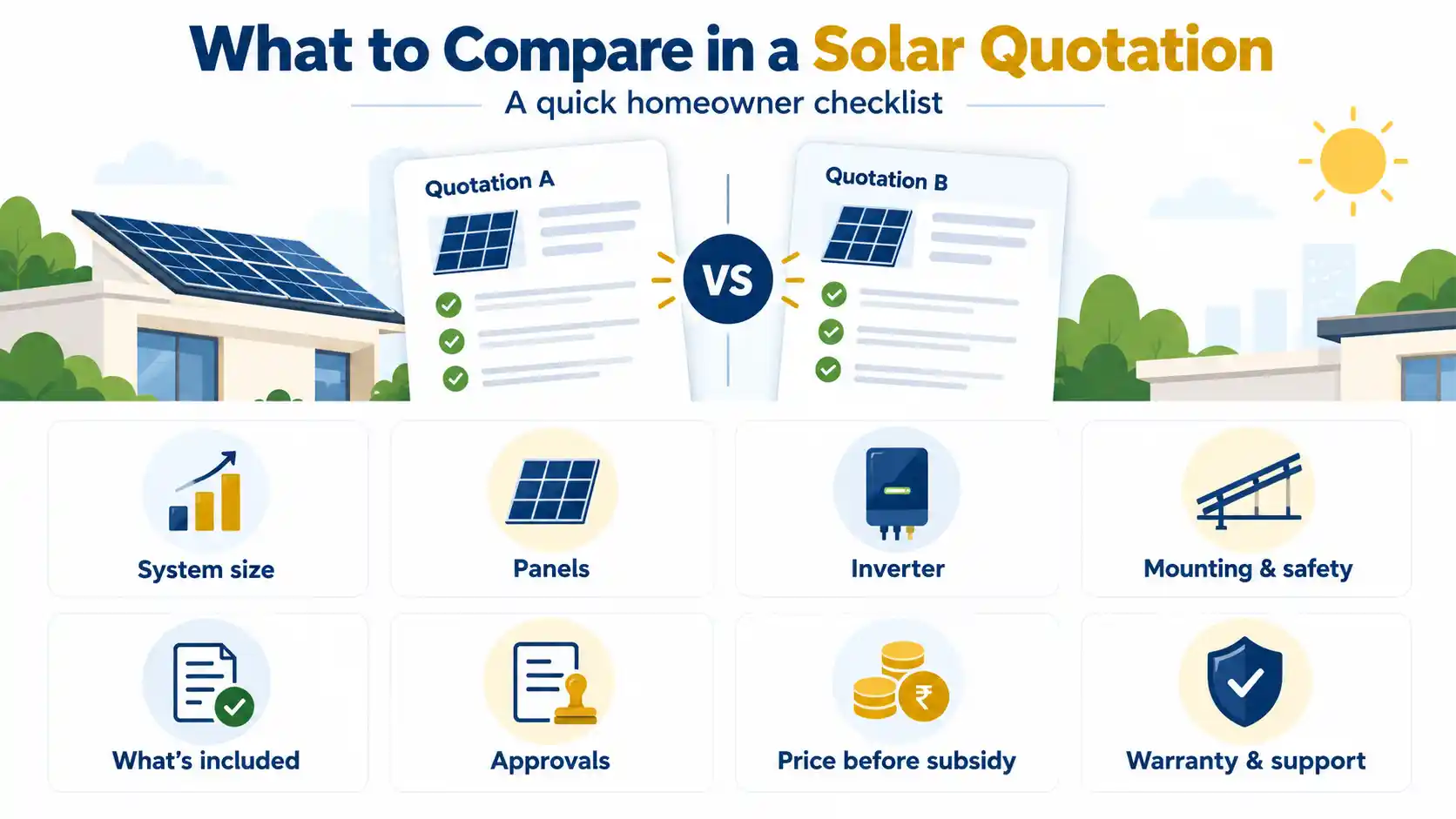
Here is a checklist you can use before making your decision.
| What to check | What to ask your installer |
|---|---|
| Panel brand and model | Which exact panel will be installed? |
| Technology | Is it Mono PERC, TOPCon or HJT? |
| Panel efficiency | How efficient is this particular model? |
| Panel size | How many panels can safely fit on my roof? |
| Heat performance | What does its temperature coefficient indicate? |
| Warranty | What is covered, and who handles claims? |
| Complete system | Which inverter and mounting structure are included? |
| Installation cost | What is included and excluded from the quotation? |
| Expected generation | What site-specific assumptions support the estimate? |
| Subsidy compliance | Does the exact proposed equipment meet the applicable scheme requirements? |
A quotation that clearly answers these questions is easier to evaluate than one that only promises the latest technology.
A note about government subsidy
If you are planning a residential rooftop solar installation under PM Surya Ghar: Muft Bijli Yojana, check the applicable equipment and scheme requirements before finalising your purchase.
The scheme has Domestic Content Requirement (DCR) provisions relating to the manufacturing of solar cells and modules in India.
Relevant module documentation and verification are important.
A panel is not automatically subsidy-eligible just because it uses TOPCon, Mono PERC or HJT technology.
Ask your installer to confirm the exact panel model and its applicable compliance documentation.
Government requirements can change, so eligibility should be checked against the current official rules.
11. So, Which Solar Panel Should You Actually Choose?
Here is a simple way to look at the decision.
Choose a suitable Mono PERC panel when: It meets your technical requirements and offers good overall value at the quoted price.
Consider TOPCon when: The specific model's efficiency, heat performance or other advantages make a worthwhile difference to your installation.
Consider HJT when: Its model-specific performance and warranty terms justify the complete installed price and it meets your project's requirements.
And remember, a good panel is only one part of a good solar system.
The inverter, mounting structure, electrical safety, installation quality and after-sales support are important too.
A newer panel technology cannot compensate for a poorly planned installation.
Frequently Asked Questions
1. Is TOPCon better than Mono PERC?
TOPCon can offer higher efficiency and better temperature performance than conventional Mono PERC designs. However, the actual difference depends on the panel models being compared. Price, warranty and installation suitability also matter.
2. Is HJT better than TOPCon in hot weather?
Some HJT panels have better temperature coefficients than some TOPCon panels. But this is not true for every product. Compare the exact manufacturer specifications before deciding.
3. Which solar panel is best for homes in Tamil Nadu?
There is no single best technology for every home. Your usable roof area, electricity needs, budget, panel specifications and complete system design should guide the decision.
4. Is a 550 W solar panel better than a 450 W panel?
Not necessarily. A 550 W panel may be larger. Compare efficiency, dimensions, roof suitability and expected system-level electricity generation rather than wattage alone.
5. Are TOPCon and HJT panels eligible for government subsidy?
Technology alone does not determine eligibility. The exact module and its documentation must meet the requirements of the applicable government scheme, including domestic-content provisions where relevant.
6. Should I always buy the latest solar panel technology?
No. A newer technology can have useful advantages, but it should make sense for your installation and budget. A properly designed system using suitable equipment is more important than choosing a technology simply because it is new.
Final Thoughts: Choose the Right Panel, Not Just the Latest Technology
When comparing Mono PERC, TOPCon and HJT solar panels, it is easy to focus on which technology is newer or which panel has the highest wattage.
But those numbers don't tell the whole story.
The right solar panel is one that suits your roof, electricity requirements and budget—and comes with clear specifications and dependable support.
Before making a decision, ask for the actual panel model, understand what the quotation includes and make sure the proposed system has been designed for your property.
For homeowners and businesses in Coimbatore, Tiruvannamalai and across Tamil Nadu, a proper rooftop assessment is a better starting point than choosing a panel based on its technology name alone.
Planning to Install Rooftop Solar?
Start with a site-specific proposal and clear equipment specifications so you can make an informed decision about your rooftop solar installation.