On This Page
You've decided to install rooftop solar and have collected quotations from two or three companies.
Now comes the tricky part.
One installer quotes a lower price. Another recommends a different inverter. A third says everything is included, but the quotation doesn't explain what "everything" means.
How do you know which offer is actually better?
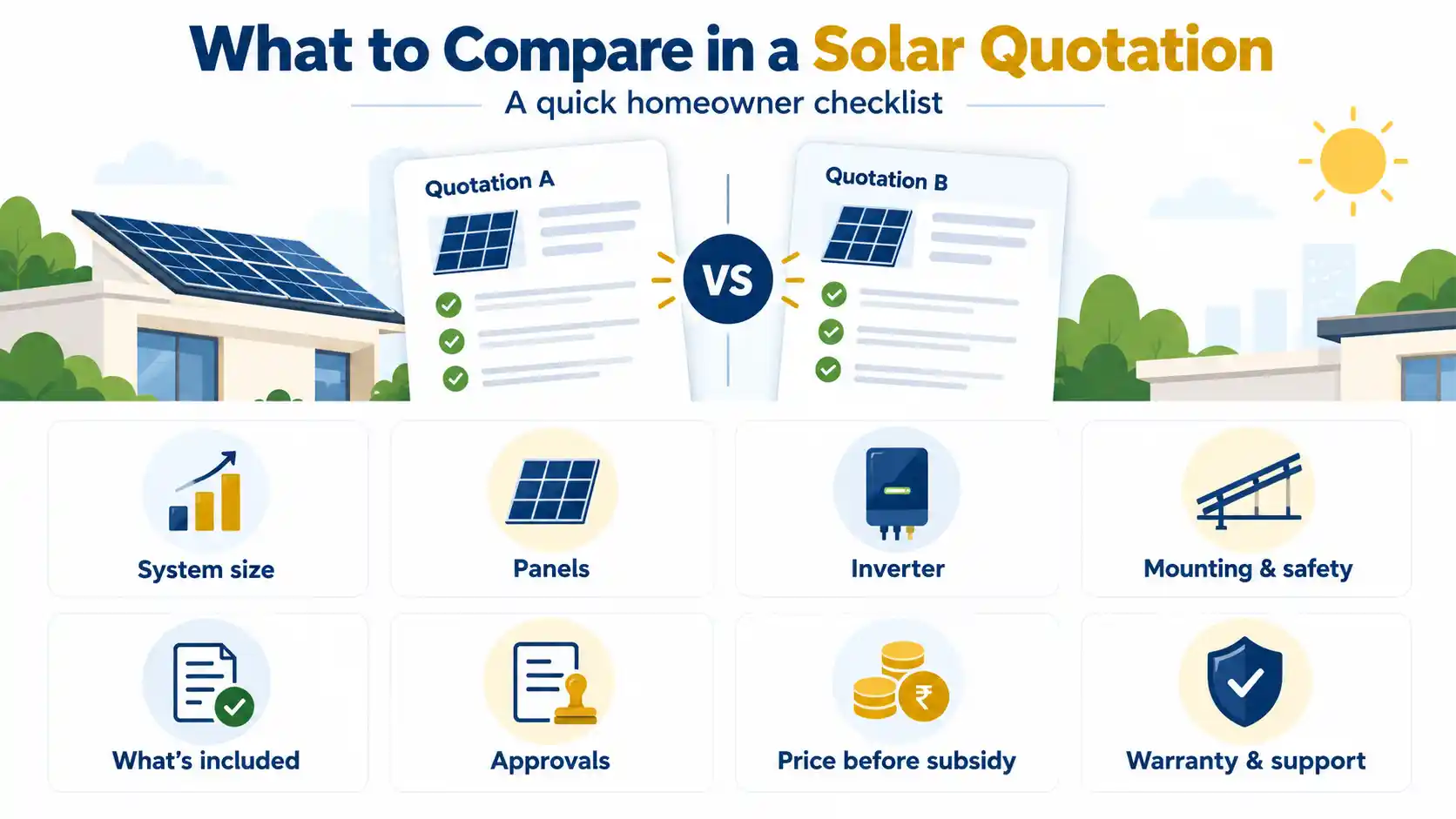
The right way to compare solar quotations is to look beyond the final price. Check the proposed system size, solar panels, inverter, mounting structure, installation work, government approvals, warranties and the total amount you'll pay.
You don't need to understand every technical detail. You just need to know what you're paying for, what's missing and what questions to ask before making a decision.
Here's a practical checklist for homeowners in Tamil Nadu.
1. Why do solar installation quotations have different prices?
Two companies may recommend a 3 kW rooftop solar system, yet their quotations can be quite different.
That doesn't automatically mean one company is overcharging.
The difference may come from the equipment being offered, the way the system will be installed, the work included in the price or the service you'll receive after installation.
For example, one quotation might clearly mention the panel and inverter models, mounting structure, electrical safety equipment and installation work.
Another might simply say "3 kW rooftop solar system — complete installation".
The second offer could still be good. But without knowing what's included, you can't compare the two fairly.
What to ask your installer:
"Can you give me a clear breakdown of the equipment, installation work and services included in this price?"
A good quotation should help you understand what you're buying without having to guess.
2. Are both installers recommending the right system size?
Before comparing prices, check whether both companies are recommending a system that suits your home.
A larger solar system isn't automatically better. The right size depends on your electricity use, available roof space, shading and other site conditions.
If one installer recommends 3 kW and another recommends 5 kW, don't compare the two prices directly.
First, ask why they recommended different sizes.
A useful starting point is to share your recent electricity bills and ask how the installer arrived at the proposed capacity.
Also check whether both are proposing the same kind of system.
For example, a regular on-grid solar system and a hybrid system with battery backup are not the same product. Their equipment, functions and costs will differ.
Three questions worth asking:
- How did you decide the solar system size for my home?
- Have you checked my roof space and whether nearby buildings or trees cause shading?
- Will this system give me backup power during a power cut?
The last question matters. A standard on-grid system generally shuts down during a grid power cut for safety. Don't assume your solar panels will keep supplying electricity unless the proposed system is specifically designed for backup.
One more detail: ask for the total solar panel capacity and inverter capacity separately. They're different ratings, and both should appear in the quotation.
3. Check which solar panels and inverter you're getting
Solar panels and the inverter are two of the most important parts of your system.
But knowing the brand names alone isn't enough.
Solar panels: what should you check?
Ask the installer to mention:
- Solar panel manufacturer and exact model
- Wattage and number of panels
- Total solar panel capacity
- Product warranty
- Performance warranty
Why does the exact model matter?
Because the same manufacturer may sell different panel models with different specifications and warranty terms.
Also, a product warranty and a performance warranty are different. One deals with covered product faults, while the other relates to the panel's output over time under specified conditions.
If you're planning to apply for PM Surya Ghar subsidy, ask whether the proposed panels meet the current scheme requirements. The installer should be able to explain this and provide supporting documents.
Solar inverter: what should you check?
The inverter converts the electricity produced by your solar panels into electricity suitable for use in your home's electrical system.
When comparing quotations, ask:
- Which inverter brand and model are you providing?
- Is its capacity suitable for the proposed solar panels?
- Is it an on-grid or hybrid inverter?
- What warranty does it come with?
- Can I monitor my solar generation?
- Who should I contact if the inverter develops a problem?
If two quotations offer different inverter models, ask each company why its choice is suitable for your home.
The takeaway: Don't compare only "Brand A versus Brand B". Compare the actual models, specifications, warranty coverage and support arrangements.
4. Don't overlook the mounting structure and installation work
Homeowners naturally pay attention to the solar panels. But how they're installed is just as important.
The mounting structure holds the panels in position and must be suitable for the roof and local site conditions.
For example, installing solar panels on a concrete terrace is different from installing them on a metal-sheet roof.
The mounting method, support design and work required may differ.
Ask the installer:
"How will the panels be fixed to my roof, and is all that work included in the quotation?"
Also find out whether any roof modification, waterproofing work or additional support will cost extra.
What about electrical safety?
A rooftop solar installation needs appropriate wiring, earthing, switching and electrical protection.
You don't need to become an electrical engineer to compare quotations.
Simply ask:
"Does your price include all the electrical protection and safety equipment needed for my system?"
A qualified installer should assess your site, design the necessary protections and explain what's included.
Don't assume that two quotations provide identical electrical work just because both say "complete installation".
5. What's included in the price, and what could cost extra?
This is one of the most useful checks you can make.
A quotation may look affordable until additional work or charges are added later.
Before paying an advance, ask the installer to explain what the quoted price covers.
| Check this item | Ask your installer |
|---|---|
| Solar equipment | Are the panels, inverter and required accessories included? |
| Mounting structure | Is everything needed to fix the panels to my roof covered? |
| Wiring and safety | Are cables and necessary electrical protections included? |
| Roof-related work | Will any additional roof or civil work cost extra? |
| Transport | Is equipment delivery to my property included? |
| Government paperwork | Who handles the application and documents? |
| Metering and connection | Which services and charges are covered? |
| Testing | Will the system be tested before handover? |
| Taxes | Is the final quotation inclusive of applicable taxes? |
| After-sales support | What service is included after installation? |
Some costs can only be confirmed after a proper site inspection. That's reasonable.
What matters is that the installer explains these possibilities before you commit.
A simple question that can prevent confusion later:
"Is there anything that's not included in this price that I may have to pay for separately?"
Ask for the answer in writing.
Still have questions about your solar quotation?
Comparing different system sizes, equipment and installation costs can get confusing. If you're unsure what would suit your home, speaking with a solar expert can help you understand what to look for before making a decision.
6. Who takes care of the electricity-board approvals?
Installing rooftop solar isn't just about fixing panels on your roof.
For a grid-connected system, there are also applications, checks and procedures involving the electricity distribution utility.
In Tamil Nadu, these are handled through the applicable electricity-board and rooftop solar processes.
You may hear terms such as net metering, grid connection, feasibility approval or commissioning.
You don't need to learn every procedure before speaking to an installer.
What you do need to know is who will take care of each step.
Ask:
"Will you help me with the electricity-board application and metering process, or do I need to arrange anything myself?"
For installations under PM Surya Ghar, the scheme sets out certain responsibilities for participating vendors, while the homeowner and electricity utility also have their own roles.
So don't accept a vague answer such as "We'll handle everything".
Get a clear explanation of:
- What the installer will do
- What documents or actions you need to provide
- Which charges are included
- Who will coordinate the final connection and testing
Official approval and connection timelines can vary. Be cautious about any promise that approval is guaranteed within a particular number of days.
7. How should you compare solar quotations that include a subsidy?
Here's where many homeowners can get confused.
One quotation may show the full installation price. Another may highlight a lower amount after subtracting an expected government subsidy.
Those figures are not directly comparable.
First compare the full installation price before subsidy. Then look at how much financial assistance you may be eligible for.
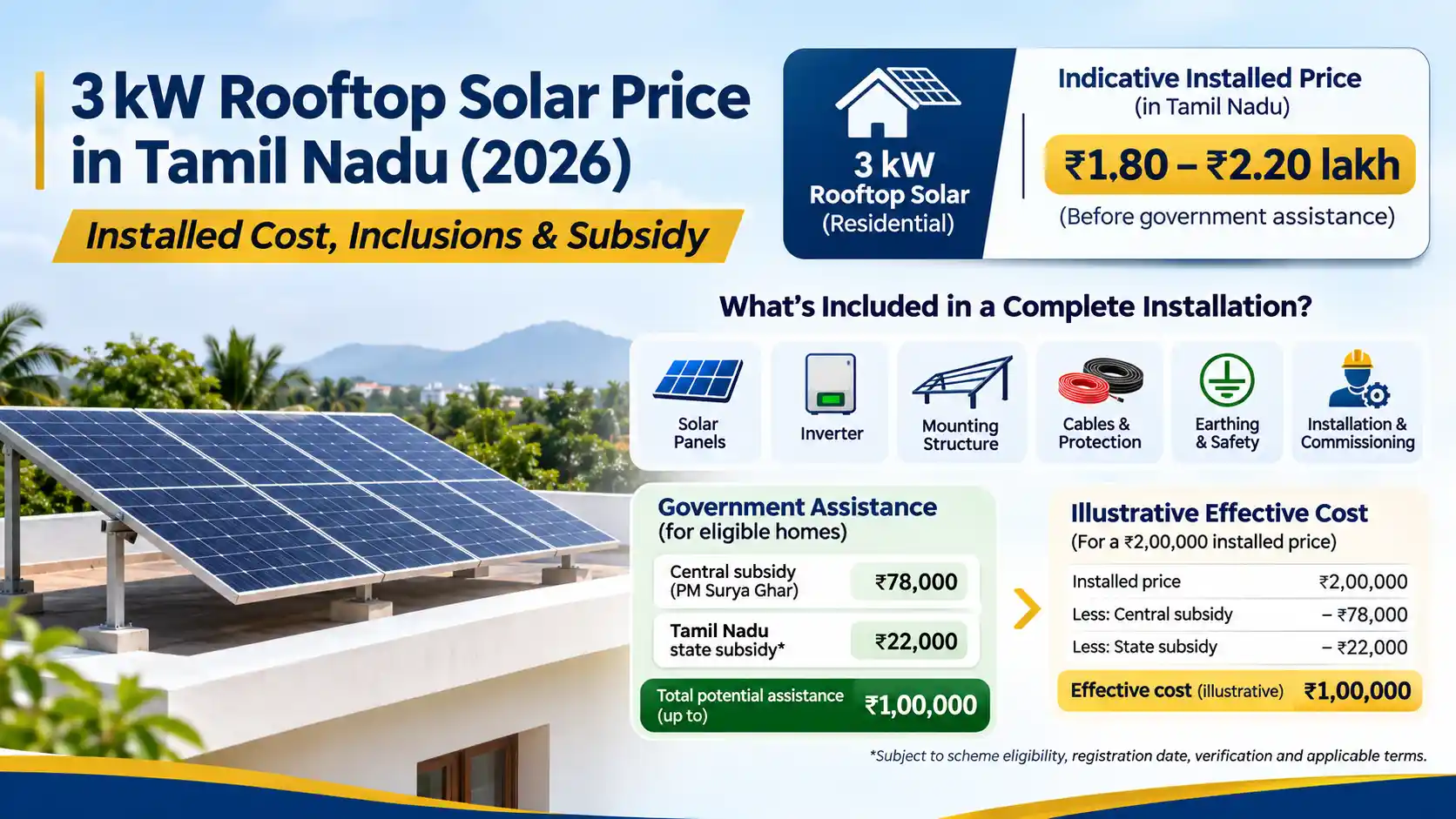
Under PM Surya Ghar, eligible residential customers can receive central government financial assistance, subject to the scheme's conditions.
Tamil Nadu's rooftop solar information also advertises additional state assistance. However, its availability and eligibility need to be confirmed against the applicable scheme rules.
Before relying on any subsidy amount shown in a quotation, ask:
- Am I eligible for this subsidy?
- Does the proposed solar system meet the requirements?
- How much assistance could I actually receive?
- When would the money be credited?
- What happens if I don't receive the amount mentioned?
The most important question is:
"If the subsidy doesn't come through, how much will I have to pay?"
Make sure you understand the payment terms clearly.
A subsidy can make rooftop solar more affordable, but it should never be presented as guaranteed money until your eligibility and the applicable conditions have been confirmed.
8. What warranty and maintenance support will you receive?
A solar quotation shouldn't end with installation.
You also need to know what happens after the system starts working.
Suppose your inverter develops a fault or your monitoring system stops showing generation data.
Whom do you contact?
Will the installer help? Does the manufacturer handle it? Could there be additional charges?
These are questions worth asking before you choose a company.
There are different warranties to understand:
Solar panel product warranty: Covers eligible product faults under the manufacturer's terms.
Panel performance warranty: Covers the manufacturer's stated output-performance commitments under specified conditions.
Inverter warranty: Covers eligible inverter problems according to the manufacturer's warranty.
Installation or system warranty: Covers the obligations described in the installation agreement.
Maintenance: Explains what checks, repairs or support the vendor must provide during the agreed period.
Is solar maintenance free for five years?
Under PM Surya Ghar, the published scheme framework includes five years of free comprehensive maintenance by the participating vendor for eligible installations.
Before signing, ask what this covers in practice, who you should contact for service, and whether any situations or charges are excluded under the applicable terms.
For any installation, whether subsidy-supported or not, get the warranty and service details in writing.
A longer warranty on paper is useful only when you understand what it covers and how to claim service when needed.
9. Use this checklist to compare two solar quotations
Now that you know what to check, put both quotations side by side.
You can copy the table below into a notebook or spreadsheet and fill it using the actual written offers.
| What to compare | Quotation A | Quotation B |
|---|---|---|
| Solar system capacity | ______ | ______ |
| Panel brand and model | ______ | ______ |
| Number and wattage of panels | ______ | ______ |
| Inverter brand and model | ______ | ______ |
| Mounting structure | ______ | ______ |
| Installation and electrical work | ______ | ______ |
| Government application assistance | ______ | ______ |
| Metering and connection costs | ______ | ______ |
| Warranty and maintenance | ______ | ______ |
| Full price before subsidy | ______ | ______ |
| Estimated subsidy, if eligible | ______ | ______ |
| Any additional charges | ______ | ______ |
| Payment terms | ______ | ______ |
Don't worry if you can't fill every row immediately.
A blank answer tells you exactly what to ask the installer.
How to make the final comparison
Once you have the missing information, ask yourself:
Are both systems suitable for my home? Check the proposed capacity and design.
Am I getting comparable equipment and installation work? Compare what's actually included, not just brand names.
Do I understand the total cost? Consider the full price, any exclusions and the payment terms.
Do I know what happens after installation? Check warranty, maintenance and support.
If one quotation costs more, look for a meaningful reason. It may include different equipment, additional work or better-documented services.
If one quotation costs less, that's not a problem by itself. Just make sure nothing important has been left out.
10. Warning signs to watch for before signing
Not every incomplete quotation is a warning sign. Some details may depend on a site survey.
But you should ask more questions if an installer:
- Won't specify which panels or inverter will be supplied
- Doesn't explain how the proposed system size was chosen
- Promises guaranteed electricity savings without explaining the assumptions
- Says the subsidy is guaranteed without checking eligibility
- Won't clarify what's included and what costs extra
- Gives only verbal assurances about warranty or maintenance
- Can't explain who handles the paperwork and connection process
- Changes important equipment or prices without written agreement
- Pressures you to pay before your questions are answered
You don't need to reject a quotation because one detail is missing.
Give the installer an opportunity to explain it and update the offer.
What matters is whether you receive clear answers before making a financial commitment.
Frequently asked questions about solar quotations
1. Should I choose the cheapest solar installation quotation?
Not necessarily. The cheapest offer may be good value, but first check the proposed capacity, equipment, installation scope, warranty and additional charges. Choose based on the complete offer rather than headline price alone.
2. How do I know whether a solar quotation is reasonable?
Ask for an itemised quotation and compare it with other offers for a similar system. Check the equipment models, roof-related work, safety provisions, included services, payment terms and warranty. If the price differs significantly, ask the installer to explain why.
3. Can I compare solar installation prices per watt?
Yes, price per watt can be a useful comparison when both quotations use the same capacity basis and include a similar scope of work. On its own, however, it won't tell you whether important equipment, installation work or services are missing.
4. Does a rooftop solar quotation include the electricity-board approval process?
Don't assume that every quotation includes the same assistance or charges. Ask who handles applications, documentation, metering and connection. For PM Surya Ghar installations, also check the responsibilities set out under the applicable scheme.
5. Should the solar quotation show the price before subsidy?
Yes. Ask for the full installation price and any expected subsidy to be shown separately. This makes it easier to compare offers and understand what you must pay if financial assistance is delayed or unavailable.
6. What if the installer changes the panel or inverter model after I agree?
Ask for the replacement model's specifications, warranty and any price difference in writing. Review and approve material changes before installation rather than assuming the replacement is equivalent.
7. How many solar quotations should I compare?
Getting two or three detailed quotations is often a practical starting point. The goal isn't to collect as many prices as possible. It's to understand your options well enough to make a confident decision.
Before you say yes to a rooftop solar quotation
You don't have to become a solar expert to choose an installer.
You just need clear answers to a few important questions:
- Is this the right solar system for my home?
- Do I know exactly which equipment I'm getting?
- Is the necessary installation work included?
- Are there any possible additional charges?
- Do I understand the subsidy conditions and payment terms?
- Who will help with approvals and connection?
- What happens if something goes wrong after installation?
If you can answer these questions confidently, you're in a much better position to compare quotations fairly.
The best solar quotation isn't necessarily the cheapest or the most expensive. It's the one that offers a suitable system, explains the full cost and makes the installer's responsibilities clear.
Planning rooftop solar for your home in Tamil Nadu?
Whether you're considering solar for your home in Coimbatore, Tiruvannamalai or elsewhere in Tamil Nadu, start by understanding what kind of system may suit your property.
Request an estimate from Scaler Solar and use the checklist in this guide to review the proposed equipment, installation work and costs before making your decision.