On This Page
Solar panels may come with a 25-year or 30-year performance warranty. But does that mean your entire rooftop solar system is protected for that long?
Not necessarily.
When you install rooftop solar, different parts of the system usually have different warranties. The solar panels have product and performance warranties, the inverter has its own warranty, and the installer has separate responsibilities for installation quality and service.
Understanding these differences can help you avoid confusion if something goes wrong.
This guide explains what solar warranties cover in India, who is responsible for different problems, and what homeowners should check before choosing a solar installation company.
1. What Are the Different Types of Solar Warranties?
A rooftop solar system includes panels, an inverter, mounting structures, wiring and electrical protection equipment.
These components do not necessarily share one warranty.
| Warranty type | What it generally covers | Who is responsible? |
|---|---|---|
| Panel product warranty | Eligible manufacturing defects in solar panels | Panel manufacturer |
| Panel performance warranty | Minimum warranted panel power output over time | Panel manufacturer |
| Inverter warranty | Covered inverter defects and failures | Inverter manufacturer |
| Installation workmanship warranty | Problems caused by defective installation work | Installation company, subject to the agreement |
| System warranty and maintenance | Specified system-level repairs and service | Vendor, according to the applicable scheme and contract |
The key takeaway is simple:
A long warranty on your solar panels does not automatically mean your inverter, installation work and every other component have the same coverage.
Before accepting a quotation, check the warranty applicable to each major part of the system.
2. Solar Panel Product Warranty: What Does It Cover?
A product warranty generally protects against qualifying defects in a solar panel's materials or manufacturing.
For example, if a panel develops an internal defect that prevents it from functioning normally, it may qualify for a warranty claim.
The manufacturer determines whether the problem is covered under its warranty conditions and applicable law.
How long does a product warranty last?
Product-warranty periods vary across manufacturers and models.
For example, Waaree's published warranty statement for specified Elite N-type TOPCon modules provides a 12-year product warranty and a separate 30-year power-output warranty.
Those periods apply to the models covered by that document, not every Waaree panel.
The important point is that you must check the warranty for the exact panel model being installed.
What happens if a covered panel fails?
Depending on the manufacturer's warranty terms, the remedy may involve repair, replacement, additional modules or a refund.
However, the manufacturer may not cover every associated expense, such as removing the old panel or installing the replacement.
Ask your installer to explain both the warranty coverage and how the claim will be handled.
3. Solar Panel Performance Warranty: What Do 25 or 30 Years Mean?
Solar panels gradually lose some power-producing capability as they age. This is called degradation.
A performance warranty specifies how much of the panel's original rated power it should retain over time, according to the manufacturer's stated conditions.
For example, a manufacturer might provide a 30-year performance warranty promising that the panel's tested output will remain above a specified percentage of its original rating.
That is different from guaranteeing how much electricity your house will generate every year.
Does a 30-year performance warranty guarantee 30 years of electricity savings?
No.
Your rooftop solar system's actual electricity generation depends on several factors, including sunlight, weather, shade, dust and the condition of the other system components.
A performance warranty concerns the panel's warranted power output under defined testing conditions.
It does not guarantee a fixed number of electricity units or a particular reduction in your electricity bill.
A practical example
Suppose your solar system starts generating less electricity than expected.
That does not automatically mean the panels have failed.
The reason could be increased shading, dirt accumulation, an inverter problem or a fault elsewhere in the installation.
A qualified technician may need to identify the cause before deciding whether a warranty claim is appropriate.
For a panel performance claim, the manufacturer may require a specific technical test.
Remember: A performance warranty is not the same as an electricity-generation guarantee.
4. Solar Inverter Warranty: Why Should You Check It?
The inverter is an important part of a rooftop solar system.
In a typical grid-connected installation, it converts the electricity produced by the solar panels into electricity suitable for use through the home's electrical system.
If the inverter develops a fault, the solar system may stop working properly even when the panels themselves are in good condition.
Does an inverter have a separate warranty?
Yes. Solar inverters generally have their own manufacturer warranties.
The warranty duration and terms depend on the brand and model. Some manufacturers also offer extended warranty options.
Before purchasing, confirm the exact inverter model and the warranty applicable to it.
You should also ask whether repairs are handled on-site, whether replacement labour is included and whether any service charges may apply.
What if the inverter stops working?
Contact your installer or the designated service provider.
If the inverter displays an error message, note the error code and share it with the technician.
Do not open the inverter or attempt electrical repairs yourself.
The technician can help determine whether the issue is covered by the manufacturer warranty or another applicable service agreement.
5. Installation Workmanship Warranty: What Is the Installer Responsible For?
Manufacturer warranties cover specific equipment-related issues.
But problems can also arise from the installation work itself.
Solar installation involves mounting panels securely, routing electrical cables, connecting equipment and carrying out the necessary safety checks.
A workmanship warranty generally concerns defects caused by the installation company's work, subject to the agreed scope and conditions.
What could be an installation-related problem?
Consider these examples:
Example 1: A wiring connection develops a fault.
A technician may need to determine whether the problem was caused by a defective component, installation work or another issue.
Example 2: Water leakage appears near a rooftop solar mounting point.
An inspection may be required to establish whether the installation contributed to the leakage.
Example 3: A mounting component becomes loose.
A qualified professional should inspect the system and establish why the problem occurred.
These are general examples, not accounts of actual Scaler Solar projects.
Importantly, a problem appearing after installation does not automatically prove that the installer caused it.
What should homeowners ask?
Ask your installer for written confirmation of the workmanship-warranty period, what work is covered, the complaint process and any exclusions.
Also clarify whether inspection, labour and replacement work are included.
Do not rely only on verbal assurances. Get the warranty terms in writing.
6. What Is the Five-Year Warranty Under PM Surya Ghar?
Homeowners planning a residential rooftop solar installation under PM Surya Ghar: Muft Bijli Yojana should also understand the applicable government scheme requirements.
The Ministry of New and Renewable Energy's residential Central Financial Assistance guidelines, including the July 2025 amended version, specify important vendor responsibilities.
Under the applicable residential scheme framework, these include:
- A five-year complete-system warranty from DISCOM commissioning, as described in the model consumer–vendor agreement.
- Five years of comprehensive operation and maintenance.
- Repair or replacement of non-performing or underperforming system components during the specified comprehensive maintenance period.
- Providing manufacturer warranty documents to the homeowner.
- Helping the homeowner with manufacturer warranty claims.
Does this mean the entire solar system has a 25-year warranty?
No.
The scheme's five-year system-level obligations and longer manufacturer warranties are separate.
For example, an eligible installation may have five-year system warranty and maintenance obligations under the scheme, while the solar panels carry longer manufacturer performance coverage.
After the initial system-service period, the applicable manufacturer warranties may continue according to their own conditions.
Does this apply to every rooftop solar installation?
No.
These provisions relate to installations covered by the applicable residential PM Surya Ghar scheme guidelines.
Other installations may have different contractual arrangements.
Homeowners should check the scheme requirements, their signed vendor agreement and the individual manufacturer warranties.
Not Sure What Your Solar Warranty Actually Covers?
Before choosing a rooftop solar system, it's worth understanding the warranties that come with your panels, inverter and installation work.
If you're comparing solar quotations or have questions about warranty terms, Scaler Solar can help you understand what to look for so you can make a more informed decision.
7. What Do Solar Warranties Usually Exclude?
A warranty does not automatically cover every type of damage.
Common exclusions or limitations in manufacturer documents may relate to accidental damage, certain external events, incorrect usage, unauthorised repairs or failure to follow specified maintenance instructions.
For example, damage caused by a storm may be treated differently from a manufacturing defect.
Similarly, a panel that produces less electricity because a nearby tree has grown taller may not have a manufacturing or performance defect.
Are labour and transportation charges covered?
This is an important question.
A manufacturer's warranty may provide for repair or replacement of a covered component without paying every associated installation, transport or testing expense.
Whether such charges are payable depends on the applicable warranty, service agreement and any relevant scheme obligations.
Before accepting a solar quotation, ask:
"If a component fails under warranty, who pays for inspection, labour, transport and reinstallation?"
Getting this clarified beforehand can prevent unexpected disagreements.
8. Who Should You Contact If Something Goes Wrong?
When a solar system develops a problem, homeowners may not immediately know whether the manufacturer or installer is responsible.
This simple table can help.
| Problem | Possible warranty or service category | What to do |
|---|---|---|
| Solar panel has a suspected manufacturing defect | Panel product warranty | Contact the designated service provider |
| Panel output may be below its warranted level | Panel performance warranty | Request a professional assessment |
| Inverter displays a persistent fault | Inverter warranty or system service | Record the error and contact the service provider |
| Electrical connection appears damaged | Installation workmanship or component warranty | Keep clear and arrange professional inspection |
| Leakage appears near solar mounting | Possible installation-related problem | Have the cause investigated |
| Solar generation drops unexpectedly | Several possible causes | Request a system check before assuming warranty failure |
Safety first: Never attempt to repair damaged solar wiring, open electrical equipment or disconnect rooftop solar components yourself. Panels can generate electricity whenever sufficient light falls on them, even when the normal grid supply is off.
Contact a qualified solar professional.
9. What Warranty Documents Should You Receive?
One of the most useful things a homeowner can do is maintain a complete solar installation file.
Before the installation is handed over, make sure you receive or request the following:
| Document | Why it matters |
|---|---|
| Final invoice and equipment list | Identifies the installed equipment |
| Solar panel product warranty | Explains coverage for panel defects |
| Solar panel performance warranty | States the long-term power-output guarantee |
| Panel model and serial-number records | Helps identify the installed modules |
| Inverter warranty and serial number | Supports inverter warranty claims |
| Installation/system warranty document | Records the vendor's applicable responsibilities |
| Commissioning and technical handover records | Documents the completed installation |
| Maintenance instructions and service contacts | Explains care requirements and how to request support |
Keep digital copies of these documents in a secure place.
They may be useful even several years after installation.
Why do serial numbers matter?
Manufacturers use serial numbers to identify specific equipment.
A warranty claim may require proof that the equipment is covered, along with purchase and installation information.
Without the relevant records, the claim process may become more difficult.
10. How Do You Make a Solar Warranty Claim?
The exact process depends on the manufacturer and applicable agreement, but most homeowners can begin with a few simple steps.
- Step 1: Record the issue. Note when the problem started. Keep photographs or inverter error messages where they can be collected safely.
- Step 2: Contact the installer or designated service provider. Explain the issue and request an inspection or guidance on the claim process.
- Step 3: Share the documents. Provide the relevant invoice, warranty certificate, serial number and other requested information.
- Step 4: Allow the problem to be assessed. A qualified professional may need to identify whether the issue concerns the product, installation or another factor.
- Step 5: Confirm the proposed solution. If the claim qualifies, ask whether repair, replacement or another remedy will be provided. Also clarify whether any charges apply.
- Step 6: Keep a record. Save complaint numbers, inspection findings and written communication until the issue is resolved.
Avoid unauthorised electrical repairs, which can create safety risks and may affect warranty coverage.
11. Seven Questions to Ask Before Choosing a Solar Installer
Before accepting a rooftop solar quotation, ask these questions:
- Which exact solar panel brand and model will be installed?
- What are its product and performance warranty terms?
- What warranty applies to the inverter?
- What written installation and system-warranty coverage will I receive?
- Who will help me if a component fails?
- Who pays for inspection, labour, transport and replacement work?
- Which warranty certificates and documents will I receive after commissioning?
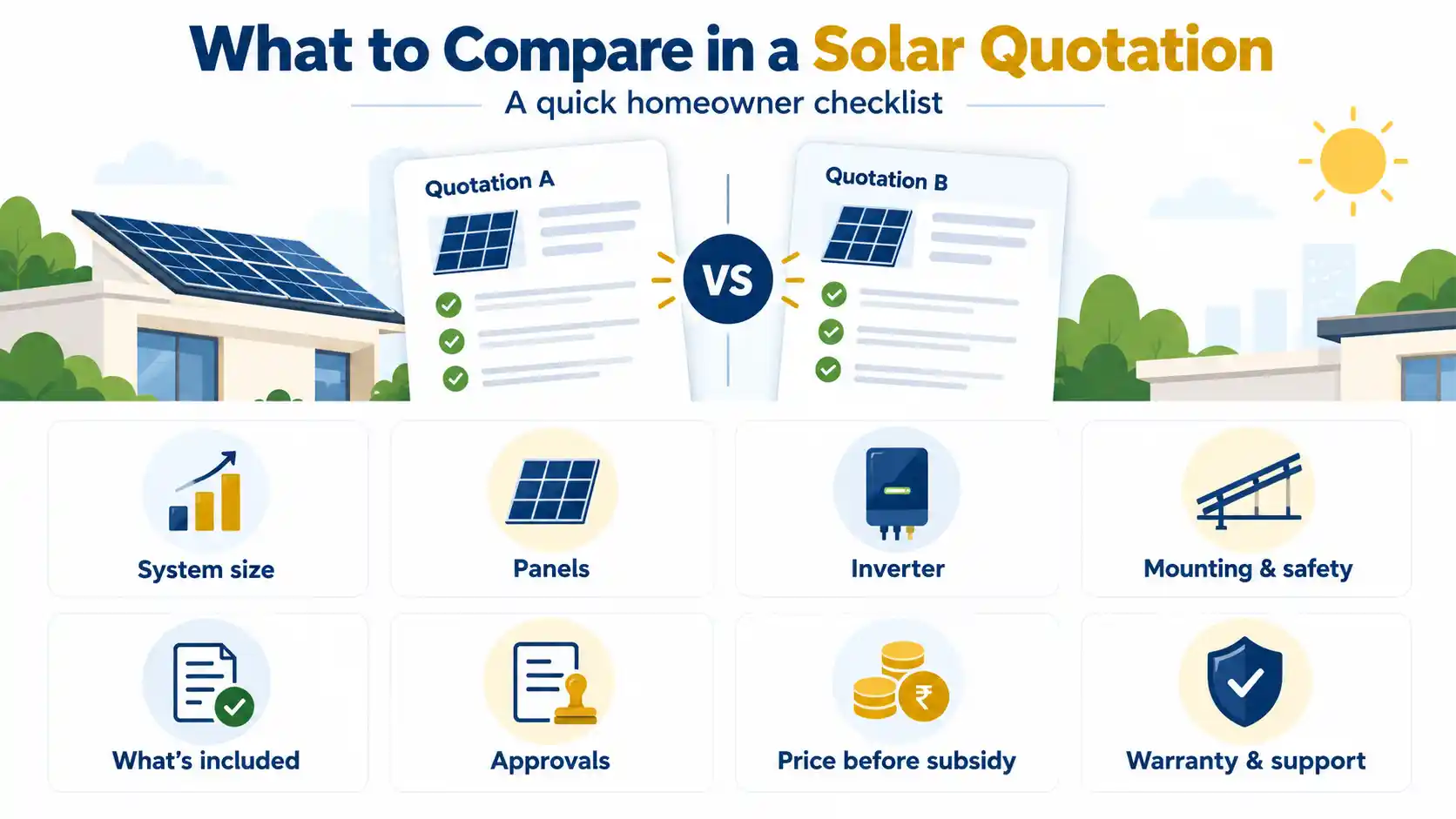
These questions can help you compare solar quotations more meaningfully.
A quotation offering a longer advertised warranty is not necessarily better if the coverage and after-sales responsibilities are unclear.
12. What Should Homeowners in Tamil Nadu Remember?
Whether you are installing rooftop solar in Coimbatore, Tiruvannamalai or another part of Tamil Nadu, understanding the warranty is an important part of making an informed purchase.
Focus on three things.
First, understand the equipment. Know which solar panels and inverter you are purchasing and what their manufacturers warrant.
Second, understand the installation agreement. Check the vendor's written responsibilities, service arrangements and exclusions.
Third, keep the documents. Maintain your warranty certificates, invoices, commissioning records and service-contact information.
If you are installing under PM Surya Ghar, check that the vendor agreement and handover documents reflect the applicable scheme requirements.
Frequently Asked Questions
Is a 25-year solar panel warranty the same as a 25-year product warranty?
No. A 25-year warranty may refer to the panel's power-output performance rather than manufacturing defects. The exact terms depend on the product.
Does a solar inverter have a separate warranty?
Yes. Inverter warranties are generally provided by the inverter manufacturer and have their own terms and conditions.
What happens if a solar panel fails during its warranty period?
If the claim qualifies, the manufacturer may provide the remedy specified in its warranty. Associated service costs should be checked separately.
Does a warranty cover roof leakage after solar installation?
Not automatically. The cause must be established, and coverage depends on the installation agreement and applicable obligations.
Is solar maintenance free for five years under PM Surya Ghar?
The applicable residential scheme guidelines specify five years of comprehensive maintenance by the registered vendor. Homeowners should check their scheme coverage and signed agreement.
What if my solar system generates less electricity than expected?
Lower generation does not automatically establish a warranty defect. Shading, weather, dirt, inverter faults and other factors may need to be assessed first.
What documents are important for solar warranty claims?
Keep the purchase invoice, applicable warranty certificates, product serial numbers, installation records and relevant fault information.
Final Thoughts: A Good Solar Warranty Is More Than a Number
Solar warranties are an important part of protecting your rooftop solar investment.
However, the number of warranty years tells only part of the story.
Before installing solar, understand what each warranty covers, who is responsible for service and what happens if a component fails.
A clear written quotation, documented warranty terms and proper handover records can help avoid confusion later.
Planning Rooftop Solar for Your Home?
A good solar investment starts with choosing the right system and understanding what you're getting—from equipment specifications to warranty coverage.
If you're considering rooftop solar in Coimbatore, Tiruvannamalai or elsewhere in Tamil Nadu, take the next step with Scaler Solar.
Request a residential solar estimate and review your options, including the proposed equipment, installation scope and applicable warranty terms, before making your decision.