On This Page
Installing rooftop solar can reduce a household's dependence on purchased grid electricity, but paying the full installation cost upfront is not practical for everyone.
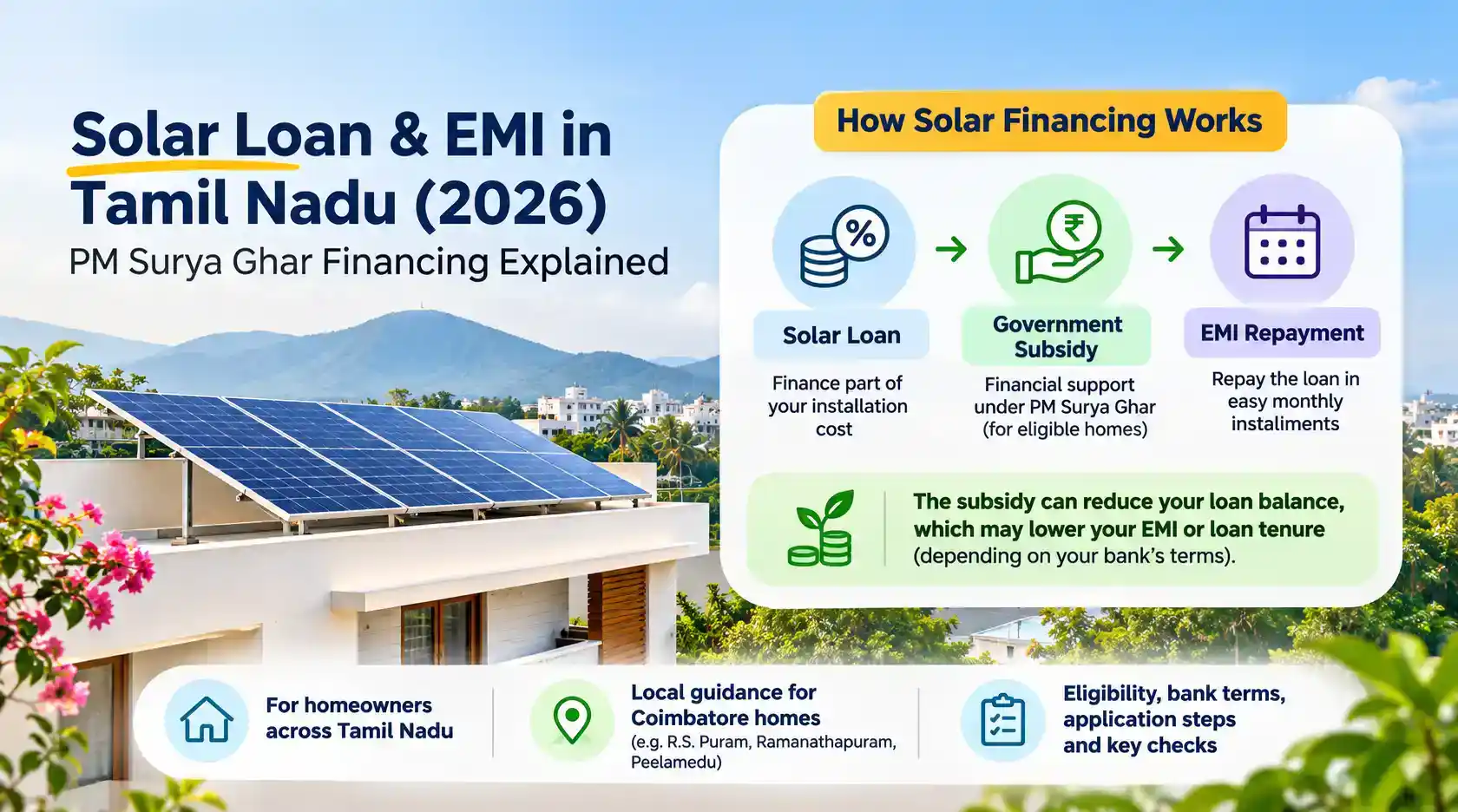
For homeowners in Tamil Nadu, a solar loan under PM Surya Ghar: Muft Bijli Yojana may make rooftop solar more accessible by allowing an eligible household to repay part of the installation cost over time.
Participating banks offer rooftop-solar financing with specific eligibility, contribution, interest-rate and repayment conditions. Some loans are available without separate collateral, although banks may retain a security interest in the financed equipment.
However, a solar subsidy, a bank loan and electricity-bill savings are three different things. Understanding how they work together is essential before accepting a quotation or signing a loan agreement.
This guide explains who can apply, how the process works in Tamil Nadu, what determines your EMI, and which questions to ask before borrowing.
Can You Get a Loan for Rooftop Solar in Tamil Nadu?
Yes. Eligible residential customers in Tamil Nadu can explore rooftop-solar loans offered by participating banks under the PM Surya Ghar financing framework.
The scheme combines government support for eligible residential rooftop-solar installations with access to financing through participating lenders.
A solar loan allows you to spread an eligible installation expense over an agreed repayment period. The bank evaluates your application and determines whether to sanction the loan.
A subsidy works differently. It is financial assistance available when the installation and applicant meet the applicable government requirements.
Receiving a solar loan does not automatically guarantee subsidy eligibility, and registering for PM Surya Ghar does not guarantee loan approval.
Before proceeding, check three things:
- Whether your residential property and proposed installation meet the scheme requirements.
- Whether your selected bank considers you eligible for financing.
- Whether you can comfortably meet repayment obligations, including before any subsidy is received.
A technically suitable rooftop-solar installation and an affordable loan are related decisions, but each needs its own assessment.
How PM Surya Ghar Solar Financing Works
The financing process involves several parties: the homeowner, the bank, the solar installation company, the electricity distribution utility and the government scheme administration.
Understanding their different responsibilities helps avoid confusion.
| Participant | Main responsibility |
|---|---|
| Homeowner | Applies for the scheme and loan, provides documents, contributes applicable funds and repays borrowing |
| Bank | Assesses eligibility, sanctions and disburses the loan, and administers repayment |
| Solar installer | Provides the quotation, required technical documentation and installation services |
| Electricity utility | Handles the applicable rooftop-solar application, inspection and grid-connection process |
| Government scheme administration | Determines and processes eligible financial assistance under applicable rules |
For the bank products examined in this guide, the published process involves PM Surya Ghar registration followed by a financing application through Jan Samarth.
However, submitting an online application is not the same as obtaining final loan sanction.
The bank may need to examine the applicant's documents, installation quotation and other requirements before approving and disbursing funds.
The homeowner should confirm the exact application sequence with the selected bank and the relevant utility.
Who Is Eligible for a Rooftop Solar Loan?
Eligibility depends on the bank's lending policy and the applicant's circumstances.
The published terms of SBI and Indian Bank demonstrate that lenders may consider several factors.
1. Residential property and rooftop rights
Banks commonly require the applicant to have the necessary rights over the rooftop where the solar installation is proposed.
Having enough usable roof space also matters.
A house may have substantial roof area but still require an assessment of shading, structure, accessibility and installation suitability.
Applicants living in shared buildings or using rooftops with uncertain ownership or usage rights should clarify eligibility before proceeding.
2. Electricity connection
A valid residential electricity connection is generally important for the scheme and financing process.
Banks may request the latest electricity bill to verify the connection and applicant details.
If the electricity connection is in another person's name, ask the bank and the scheme administrator how the mismatch should be handled before applying.
3. Income and repayment capacity
Banks may examine income and financial information according to the loan amount and lending category.
Some rooftop-solar loan products do not specify a minimum income requirement for their smaller loan category.
Larger loans may involve additional income documentation or eligibility conditions.
The absence of a published minimum income requirement should not be interpreted as automatic approval.
4. Credit history
Credit-score requirements can also differ.
For example, SBI's published rooftop-solar financing terms distinguish its smaller loan category from loans above ₹2 lakh. Indian Bank publishes a different credit-assessment threshold.
This means a customer should not assume that a credit score accepted by one lender will automatically satisfy another.
5. Bank account and documentation
The selected bank may require an account relationship, identity verification and additional financial documents.
Requirements can also change according to the loan amount, applicant category and bank policy.
The practical approach is to check eligibility with the selected bank before making a financial commitment to the installation.
How Much Solar Loan Can You Get?
The sanctioned amount depends on the selected bank's product limits, eligible installation cost, applicant contribution and credit assessment.
The following comparison illustrates why homeowners should examine actual lender terms rather than rely on a general statement such as “solar loans are available up to a certain amount”.
Published bank-product comparison
| Feature | State Bank of India | Indian Bank |
|---|---|---|
| Published maximum loan amount | Up to ₹6 lakh | Up to ₹6 lakh |
| Smaller loan category | Up to ₹2 lakh | Up to 3 kW, with a published loan cap of ₹2 lakh |
| Applicant contribution | Published minimum of 10% of project cost | Published minimum of 10% for up to 3 kW and 20% for above 3 kW to 10 kW |
| Published maximum repayment period | 120 months, including moratorium | 120 months, including moratorium |
| Interest-rate structure | Floating-rate product | Rate depends on applicable lending category |
| Final approval | Subject to bank assessment | Subject to bank assessment |
Every bank has its own eligibility requirements, interest rates and repayment options. Use this comparison as a starting point, and check the latest terms with your preferred bank before making a decision.
Why the installation quotation matters
The bank will need to understand what is being financed.
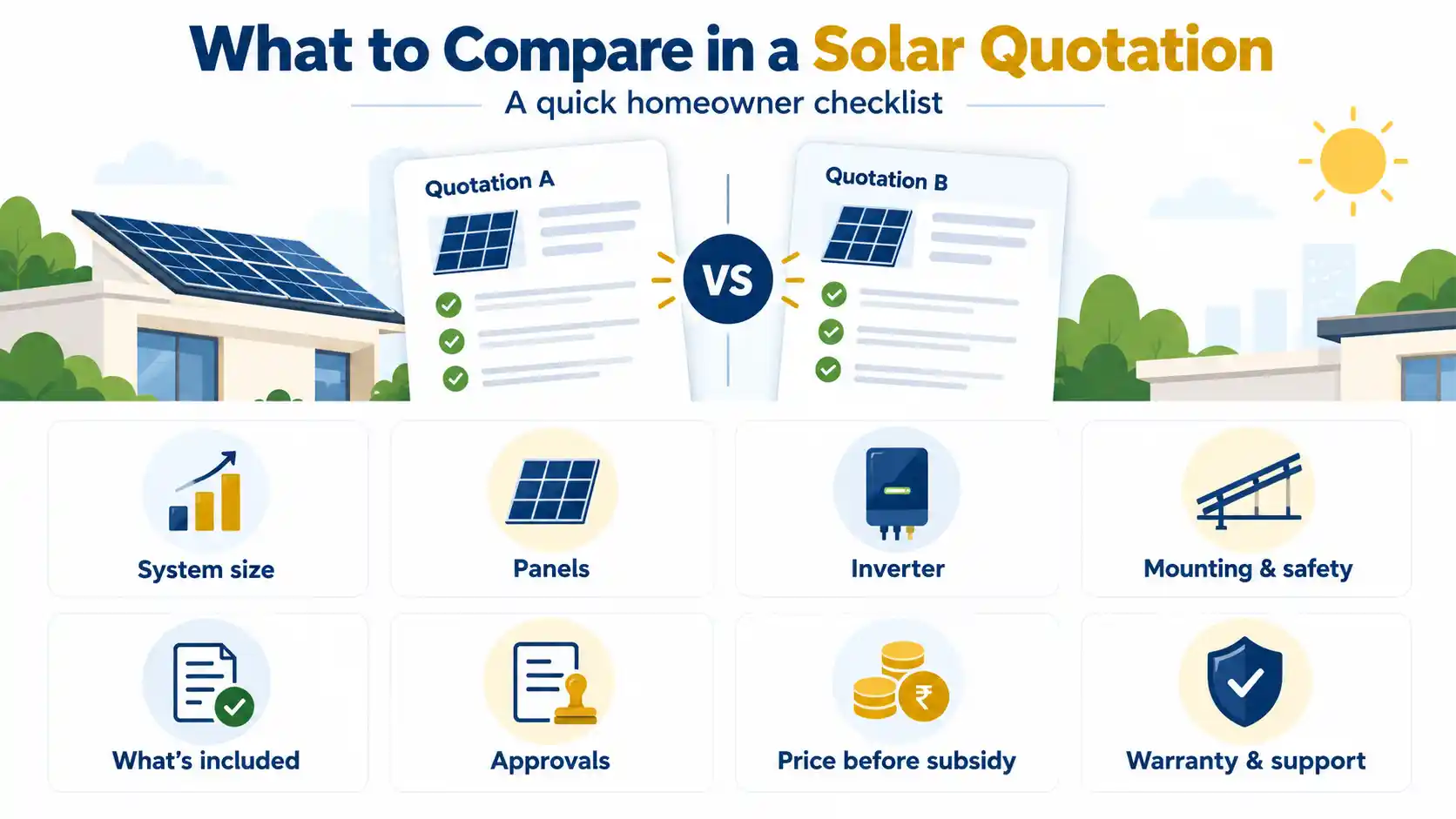
A rooftop-solar quotation should clearly identify the system capacity, equipment, installation scope and total quoted price.
It is also important to establish which expenses the bank considers eligible for financing.
For example, an installation may require work that is not covered by the selected loan product. If those expenses are excluded, the homeowner may need additional funds.
Ask the installer and bank to identify the complete payable amount rather than comparing only the nominal solar-system capacity.
How much money must you contribute?
The amount the homeowner pays from personal funds is often called the borrower's margin or contribution.
A bank financing part of an eligible project does not necessarily mean it will finance the entire installation.
The contribution percentage and method of payment depend on the lender.
Before agreeing to the installation, establish the amount you must arrange independently, the stage at which it is required and any other charges that remain your responsibility.
Solar Loan Interest Rates and EMI: What Should You Compare?
EMI stands for Equated Monthly Instalment. It is the scheduled repayment amount under the loan agreement, generally comprising principal and interest.
Your EMI depends on the loan principal, applicable interest rate, repayment tenure and repayment structure.
For a rooftop-solar loan, the total financing decision should account for more than the advertised rate.
Fixed versus floating interest
A fixed interest rate remains fixed according to the terms of the lending agreement.
A floating interest rate can change when the applicable benchmark or bank lending rate changes.
SBI publishes its PM Surya Ghar rooftop-solar loan as a floating-rate product.
This matters because the repayment amount or loan tenure may change according to the loan agreement.
A homeowner should obtain the bank's current written rate and understand how future changes will be handled.
Loan tenure
A longer repayment period can make the scheduled instalment smaller, all else being equal.
However, extending the repayment period may increase the total interest paid.
A shorter repayment period generally creates a higher monthly repayment obligation but can reduce the overall interest cost.
The best choice is not automatically the lowest EMI. It is the repayment structure that fits your household budget and financial priorities.
Moratorium period
Some solar-loan products provide a moratorium period.
A moratorium does not automatically mean the bank charges no interest during that period.
Ask whether interest accrues, whether payments are deferred and how the bank calculates the instalments once regular repayment begins.
Processing charges, insurance and other costs
Some published solar-loan products waive processing fees.
However, the customer should still check for applicable insurance, documentation expenses, statutory charges and other loan-related costs.
Do not assume that a zero processing fee makes the entire financing arrangement free of additional expenses.
A practical EMI comparison framework
Before selecting a loan, request these figures in writing:
| Item | What it tells you |
|---|---|
| Eligible project cost | The installation expense accepted by the bank |
| Sanctioned loan amount | The principal the bank agrees to finance |
| Your contribution | Funds you must arrange separately |
| Interest rate and benchmark | How borrowing costs are calculated and may change |
| Repayment tenure | How long the loan remains payable |
| Moratorium treatment | When payments begin and how interest is handled |
| EMI before subsidy adjustment | Your initial repayment obligation |
| Subsidy adjustment method | How eligible assistance affects the outstanding loan |
| Total amount repayable | Principal, interest and applicable financing costs |
A useful bank comparison should use the same project quotation and clearly stated assumptions wherever possible.
Comparing EMI figures based on different loan amounts or tenures can be misleading.
What Happens to Your Solar Loan After the Subsidy Arrives?
This is one of the most important questions for a homeowner financing rooftop solar.
A solar loan and a government subsidy should not be treated as if they are received at the same time.
The loan helps finance eligible installation expenses according to the bank's sanction and disbursement process. The subsidy is subject to the applicable government requirements and processing procedure.
How does the subsidy affect your solar loan?
If you're taking a loan for rooftop solar, it's important to understand what happens when your subsidy is received.
Depending on your bank's loan terms, the subsidy may be used to reduce your outstanding loan amount. This could lower your monthly EMI or shorten your repayment period.
However, the subsidy may take time to arrive, and your repayments won't necessarily change immediately.
Before choosing a loan, ask your bank how the subsidy will be adjusted and what your repayments will look like before and after receiving it.
The safest approach is to choose an EMI you can comfortably afford even while waiting for the subsidy.
Questions to ask your bank
Ask where any eligible subsidy will be credited, whether your EMI or loan tenure could change, and when the revised repayment schedule would begin.
Also ask what happens if the subsidy is delayed, reduced or not approved. Get the answer in writing before you commit.
Why you should not calculate affordability using subsidy alone
First, check whether you can manage the initial repayment amount. Then consider how an eligible subsidy could change the remaining loan balance under your bank's terms.
For the latest subsidy eligibility and amount information, consult the current PM Surya Ghar requirements and Scaler Solar's dedicated Tamil Nadu solar subsidy guide.
How to Apply for a Solar Loan in Tamil Nadu
The application process includes national scheme registration, bank financing and Tamil Nadu's utility requirements.
These are related processes, but they serve different purposes.
Step 1: Check your rooftop and electricity connection
Start by confirming that the property has a valid electricity connection and that the rooftop can be assessed for the proposed solar installation.
Review your electricity consumption to understand the capacity you may need.
The correct system size should reflect the property's requirements and technical feasibility, rather than the maximum capacity a bank is willing to finance.
Step 2: Obtain a suitable installation quotation
Request a written rooftop-solar quotation with clear system specifications and installation scope.
The quotation should identify the equipment, total quoted price and relevant technical responsibilities.
Do not select a system solely because its EMI looks attractive.
Step 3: Register through the PM Surya Ghar National Portal
Eligible residential applicants seeking assistance under the scheme should follow the current registration process on the official PM Surya Ghar portal.
Retain the reference number and other application details.
Step 4: Complete the relevant Tamil Nadu utility process
Tamil Nadu's Unified Solar Rooftop Portal FAQ states that residential consumers applying for PM Surya Ghar subsidy register through the National Portal and use the generated reference number for the relevant state utility application.
The FAQ also describes the associated application-charge and status-tracking procedures.
Follow the current portal instructions for your electricity service connection.
Step 5: Apply for financing
SBI and Indian Bank direct applicants to the Jan Samarth route following the relevant PM Surya Ghar registration.
Check the participating lender's current requirements before submitting the financing application.
An initial digital eligibility or in-principle decision may still be subject to document verification and final bank sanction.
Step 6: Review loan sanction and disbursement
Read the sanctioned amount, interest-rate provisions, repayment terms and disbursement conditions.
The examined bank schemes describe direct disbursement to eligible solar vendors or EPC contractors after the required checks.
Confirm when your own contribution is payable and how the installer will receive the financed amount.
Step 7: Complete installation and applicable approvals
The installation must follow the required technical and utility process.
The relevant parties should confirm the necessary documentation, inspection, grid connection and commissioning requirements.
The homeowner should retain the installation and approval records.
Step 8: Complete the subsidy claim and repayment follow-up
After meeting the applicable scheme conditions, complete the required subsidy procedure.
Where the loan terms require subsidy credit to the loan account, ensure the relevant account details are correctly provided.
After any applicable subsidy adjustment, request an updated loan statement or repayment schedule from the bank.
What Should Coimbatore Homeowners Check Before Applying?
For homeowners planning rooftop solar in Coimbatore, including areas such as R.S. Puram, Ramanathapuram and Peelamedu, understanding the installation requirements is just as important as comparing bank interest rates.
Before applying for a solar loan, confirm your electricity connection details, rooftop ownership or usage rights, proposed system capacity and complete installation quotation.
For apartments or houses with shared rooftop arrangements, clarifying who has the right to use the roof is particularly important before making financial commitments.
These considerations depend on the individual property and lender—not simply the neighbourhood. A proper rooftop assessment and a clearly documented quotation can help homeowners prepare for the financing process and avoid unexpected installation costs.
Whether your home is in R.S. Puram, Ramanathapuram or another part of Coimbatore, the right starting point is to evaluate the property's solar suitability and obtain a transparent installation estimate before selecting a loan.
Documents to Prepare Before Applying
Document requirements vary according to the lender, loan amount and applicant circumstances.
The following checklist can help homeowners prepare for a bank discussion.
| Document or information | Why it may be needed |
|---|---|
| Identity and address documents | Applicant verification |
| Latest electricity bill | Electricity connection and consumer details |
| Bank account information | Banking and loan processing |
| Income documents, where required | Assessment of repayment capacity |
| PAN, where applicable | Financial identification and bank compliance |
| Rooftop ownership or usage-right information | Property and installation eligibility |
| Solar installation quotation | Project-cost and financing assessment |
| Site feasibility and technical documents | Installation and lending requirements |
| Scheme application reference | Linking the financing process to the relevant application |
| Vendor or installation agreement | Confirmation of installation scope and contractual responsibilities |
This is a preparation checklist, not a claim that every bank requires every item.
Always follow the final checklist supplied by your selected lender.
Is Taking a Solar Loan Better Than Paying Upfront?
That depends on your finances.
A solar loan can reduce the amount you must pay immediately, but it introduces repayment obligations and borrowing costs.
Paying upfront may avoid loan interest but requires sufficient available funds.
The decision should account for affordability, liquidity, project suitability and the expected financial benefit of the installation.
When a solar loan may be worth considering
Financing may be useful when a homeowner has a technically suitable installation opportunity but prefers to preserve funds for other household requirements.
It can also be considered when the available repayment terms fit comfortably within the household's regular budget.
However, taking a loan simply because one is available may not be sensible.
When paying upfront may make more sense
A homeowner with sufficient savings may prefer to avoid interest expenses and repayment commitments.
This choice should still preserve an appropriate financial reserve.
Do electricity savings cover the EMI?
Not necessarily.
The loan EMI is based on the borrowing arrangement.
Electricity-bill savings depend on a different set of factors, including solar generation, household consumption, applicable electricity tariffs and the electricity-billing arrangement.
Actual savings can vary over time.
You should not assume that your monthly EMI will always be lower than your electricity-bill savings.
Ask for a separately documented solar-generation and savings assessment, with clear assumptions and limitations.
Compare those estimates with the bank's actual repayment schedule before making a decision.
The correct financial question is whether the installation and financing arrangement make sense together—not whether a promotional EMI figure looks attractive.
Questions to Ask Before Signing a Solar Loan Agreement
Before committing to rooftop-solar financing, ask your bank and installer to clarify the complete financial arrangement.
| Ask the bank | Ask the solar installer |
|---|---|
| What is my applicable interest rate? | What exactly is included in the quotation? |
| Is the interest rate floating? | Which equipment and specifications are proposed? |
| How much must I contribute upfront? | What additional installation expenses might arise? |
| When does EMI repayment begin? | Which documents will you provide for the loan application? |
| Does interest accrue during the moratorium? | What technical and utility approvals are required? |
| What happens after subsidy credit? | What installation and service obligations are covered? |
| Are there insurance or other charges? | What happens if the bank sanctions less than the quoted amount? |
| Can I repay early without a penalty? | What are the payment and completion conditions? |
Request written answers to questions affecting your financial commitment.
A reliable financing decision requires clarity from both parties.
Frequently Asked Questions
Can I get a solar loan without collateral?
Some PM Surya Ghar financing products offer borrowing without requiring separate collateral.
However, the bank may retain a security interest in the solar equipment being financed.
Eligibility and security conditions depend on the lender.
Is a solar loan available without a high income?
Some banks do not prescribe a minimum income requirement for their smaller rooftop-solar loan category.
That does not guarantee approval.
The bank may still evaluate other eligibility and repayment considerations.
Can I apply for a solar loan without a good CIBIL score?
Credit-score requirements are bank-specific.
For example, SBI and Indian Bank publish different conditions for their rooftop-solar products.
Applicants should check the selected bank's current policy rather than assume one minimum score applies everywhere.
Does the subsidy automatically reduce my EMI?
No automatic reduction should be assumed.
The impact depends on when eligible subsidy funds are received and how the bank applies them.
Obtain confirmation of the revised repayment amount or schedule directly from your lender.
Can I repay my solar loan early?
Some published rooftop-solar loan products allow early repayment without a prepayment penalty.
Confirm the provision in your individual sanction letter and loan agreement.
Can I apply for a solar loan before choosing an installer?
You can explore financing eligibility and ask banks about their requirements before choosing an installer.
However, final processing and disbursement may require an acceptable quotation, technical information and other documents.
Follow the selected lender's application sequence.
Can homeowners in Coimbatore and Tiruvannamalai use the same financing scheme?
The national PM Surya Ghar framework applies across eligible locations, including Tamil Nadu.
However, actual eligibility, bank financing and utility procedures depend on the individual application.
Residents of Coimbatore and Tiruvannamalai should follow the current process applicable to their electricity connections.
Final Takeaway: Compare the Complete Solar Investment, Not Just the EMI
A rooftop-solar loan can make installation financing more manageable for an eligible Tamil Nadu homeowner.
But the decision involves more than finding a low advertised interest rate.
You need a suitable solar-system design, a clear quotation, confirmed lending terms, an affordable repayment plan and a correct understanding of subsidy eligibility and adjustment.
Before applying, determine the installation cost, your upfront contribution, initial repayment obligation and the financial impact of any eligible subsidy.
Most importantly, do not commit based on assumed electricity savings or an unconfirmed post-subsidy EMI.
A technically suitable installation and a transparent financial arrangement should be evaluated together.
Planning Rooftop Solar for Your Home?
If you are considering rooftop solar in Coimbatore, Tiruvannamalai or another area served by Scaler Solar, start with a clear assessment of your electricity requirements, rooftop suitability and installation scope.
Scaler Solar can help you explore a suitable residential solar solution and understand the installation quotation.
For lending eligibility, interest rates, sanction and repayment conditions, obtain confirmation directly from your chosen bank.
Information reviewed: 27 October 2026. Bank products, interest rates, government scheme requirements and utility procedures can change. This guide provides general information and is not a loan offer, guarantee of eligibility or personalised financial advice.