
On This Page
What should a homeowner budget for a 3 kW rooftop solar system in Tamil Nadu?
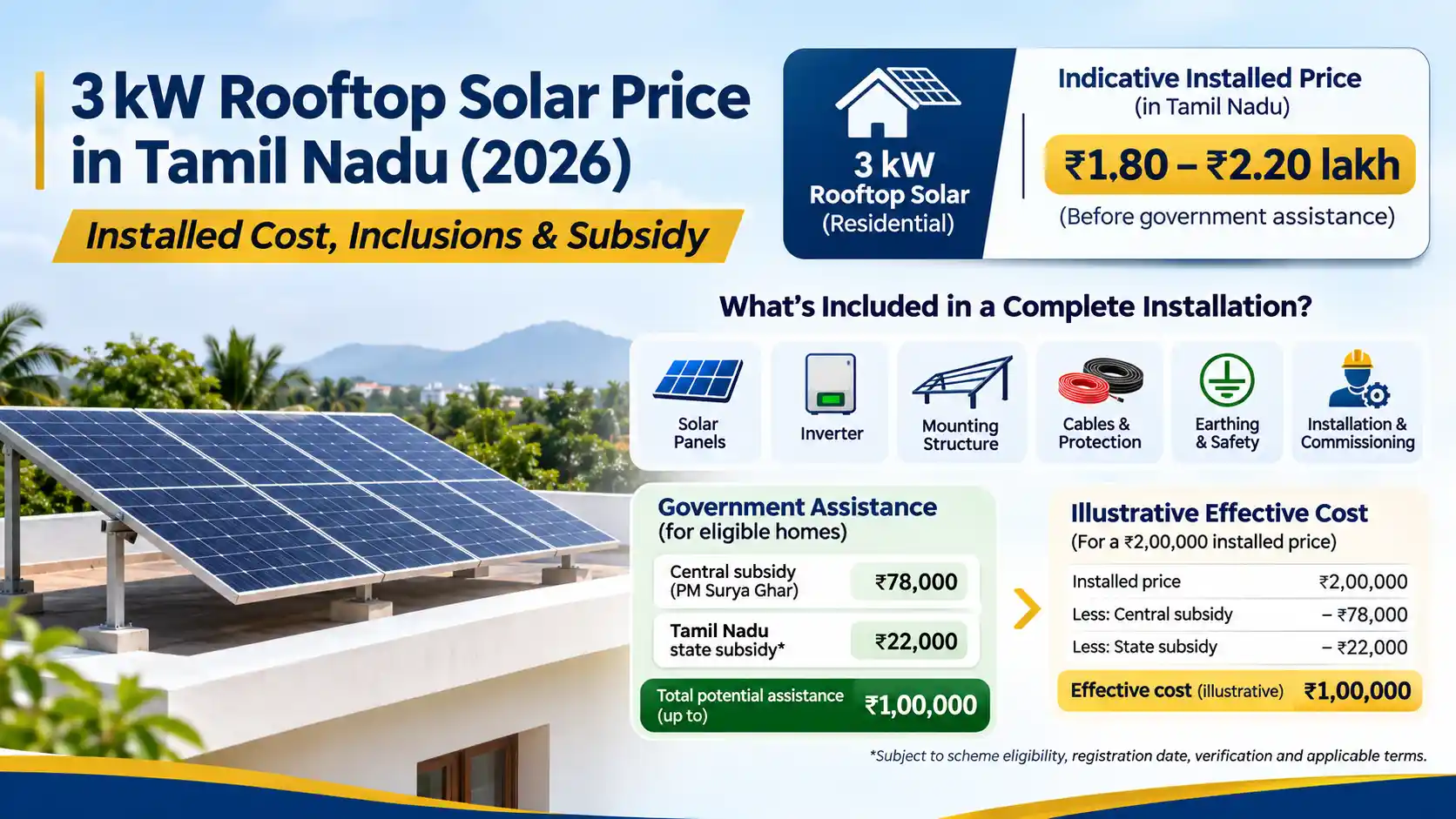
The Tamil Nadu solar portal presents an indicative market price of ₹1.80 lakh to ₹2.20 lakh for a 3 kW residential rooftop solar system, before subsidies. This is a planning reference, not a fixed installation price or a quotation from Scaler Solar.
Your actual cost depends on the solar panels, inverter, mounting structure, electrical protection, roof conditions and the work included in the installation contract.
An eligible household may qualify for central and Tamil Nadu government financial assistance totalling up to ₹1,00,000 for a 3 kW system, subject to the applicable scheme conditions. Do not assume every household will receive both components.
Before comparing prices, it is important to understand three figures:
- Gross installed price: What the supplier charges for the agreed equipment and installation work.
- Eligible government assistance: Subsidy approved under the applicable schemes, subject to verification and disbursement.
- Effective cost: Your final cost after assistance actually received, including any additional expenses not covered by the original quotation.
A low advertised price is not necessarily a lower final cost. The written scope matters.
What is included in the price of a 3 kW rooftop solar system?
A complete rooftop solar installation involves more than the solar panels.
For a typical grid-connected residential system, the main cost categories are the PV modules, inverter, mounting structure, electrical components, installation labour, testing and commissioning.
The following breakdown helps explain what you are paying for.
| Cost component | What the quotation should specify |
|---|---|
| Solar panels | Manufacturer, model, wattage, quantity and total DC capacity |
| Solar inverter | Manufacturer, model, rated capacity and grid-connected configuration |
| Mounting structure | Structure material, rooftop attachment method and whether an elevated structure is included |
| DC and AC electrical work | Cable specifications, routing, connectors, isolators and distribution/protection equipment |
| Earthing and safety equipment | Earthing scope, electrical protection and applicable surge/lightning protection requirements |
| Installation and commissioning | Labour, equipment mounting, electrical connections, testing and handover |
| Metering and approvals | Who handles documentation, inspection coordination, metering and associated charges |
| Warranty and maintenance | Equipment warranties, workmanship coverage, service obligations and exclusions |
These categories are not a fixed Scaler Solar package specification. The exact components and required protections must be determined through the system design and confirmed in writing.
A useful quotation should make it possible to identify what is included, what is optional and what may lead to an additional charge.
Why can two 3 kW solar installations have different prices?
Two quotations can both describe a 3 kW system while offering different equipment, installation methods and service responsibilities.
1. Solar panel specifications
Solar modules differ in technology, rated output, dimensions, manufacturer support and warranty terms.
The total DC capacity also matters. A quotation should state the number and wattage of modules so that the stated system size can be checked.
A higher-priced panel is not automatically the best choice. Suitability depends on the product specifications, available roof area, layout, applicable subsidy requirements and long-term support.
2. Inverter type and specifications
The inverter converts the DC electricity produced by solar panels into AC electricity used by the building and grid-connected electrical system.
Inverter specifications influence the system design and quoted cost.
For a normal grid-connected rooftop installation, do not assume that an inverter provides battery backup. Battery storage and backup-capable configurations must be explicitly specified and quoted.
3. Roof type and mounting structure
A solar installation on a reinforced concrete terrace can require a different mounting approach from one on a metal-sheet roof.
An elevated structure, additional structural work, special attachment requirements or roof preparation may affect the price.
Mounting must be assessed for the actual roof and relevant structural and wind-loading requirements. It should not be selected solely because it is the cheapest option.
4. Electrical cables and protection
The distance between the modules, inverter, distribution board and metering location can affect cable routing and installation work.
A proper design also needs appropriate isolation, earthing and electrical protection.
When comparing prices, ask whether these items have been included in the quoted amount or treated as additional work.
5. Installation access and associated work
Practical site conditions can affect the installation scope.
For example, difficult roof access, additional cable containment, roof repairs or civil work may need to be priced separately.
The quotation should identify any site-dependent work that is provisional rather than presenting the entire job as a guaranteed fixed-cost installation.
6. Warranty and after-sales responsibilities
There is a difference between a manufacturer's equipment warranty and an installer's workmanship or maintenance commitment.
Ask for the actual warranty documents and written service terms. Confirm who handles problems with modules, inverters, electrical components or workmanship after commissioning.
A promise of long-term support is useful only when its scope and responsibilities are clear.
Is ₹1.80–₹2.20 lakh the final price you will pay?
Not necessarily.
The indicative market range is a starting point for understanding the scale of investment. Your actual quotation may be above or below it depending on the confirmed scope.
Before relying on a quoted total, check whether it includes:
- Applicable taxes.
- The complete mounting structure and electrical installation.
- Any required extra civil or roof-related work.
- Metering, inspection and application-related charges.
- Testing, commissioning and handover.
- Any promised maintenance or service obligations.
A quotation that excludes major parts of the required work cannot be compared directly with an all-inclusive quotation.
The final contracted amount should be clear before you commit to the installation.
Want to know the likely cost for your own roof? An indicative price range cannot account for your electricity needs, equipment preferences or site-specific work. Request a free residential solar estimate to understand the proposed system, scope and likely installed price before deciding.
How much subsidy can you receive for a 3 kW solar system in Tamil Nadu in 2026?
Residential rooftop solar may qualify for financial assistance under the central PM Surya Ghar: Muft Bijli Yojana and the Tamil Nadu government's additional rooftop solar scheme.
As displayed on the Tamil Nadu solar portal for a qualifying 3 kW residential installation:
| Assistance component | Listed amount |
|---|---|
| Central PM Surya Ghar subsidy | ₹78,000 |
| Tamil Nadu state top-up | ₹22,000 |
| Potential combined assistance | ₹1,00,000 |
These are scheme amounts, not an automatic discount on every 3 kW solar quotation.
The state component has additional eligibility limits. Reports describing the September 2026 government order specify PM Surya Ghar registrations from 5 August 2026 and scheme coverage limited to one lakh consumers. Confirm the current order and individual eligibility before assuming the state top-up applies.
Eligibility also depends on the applicable residential category, application and installation requirements, approved equipment, vendor-registration or empanelment requirements, commissioning and other scheme conditions.
The solar portal describes the state assistance as following installation, commissioning and central subsidy disbursement. Consequently, homeowners should not assume the combined subsidy will be deducted immediately from the vendor's invoice.
Before choosing an installer, verify the current scheme requirements and the vendor's relevant registration or empanelment status.
For detailed eligibility, application steps and documents, refer to Scaler Solar's separate Tamil Nadu Solar Subsidy 2026 guide and the official government portals.
Illustrative example: how subsidy changes the effective cost
Consider a hypothetical 3 kW rooftop solar installation with a fully quoted price of ₹2,00,000.
| Illustration | Amount |
|---|---|
| Quoted installation cost (hypothetical) | ₹2,00,000 |
| Potential central assistance, if eligible | ₹78,000 |
| Potential Tamil Nadu state assistance, if eligible | ₹22,000 |
| Illustrative effective cost after both payments | ₹1,00,000 |
This calculation is an example, not a Scaler Solar price or an assurance of subsidy approval.
If the household does not qualify for a particular assistance component, receives a different amount, or has additional installation expenses, the effective cost will change.
Payment obligations to the installer and actual government disbursement dates must be checked separately. An expected subsidy should not be treated as money already received.
Does a 3 kW solar installation cost the same in Coimbatore and Tiruvannamalai?
There is no single confirmed Scaler Solar installation price that applies to every home in either city.
For a homeowner in Coimbatore, the quotation should reflect the actual terrace or roof arrangement, structural requirements, electrical layout and equipment selected.
The same is true in Tiruvannamalai. Roof type, shading, safe mounting, site access and electrical routing must be assessed for the individual property.
A city name alone does not establish the cost of an installation. A meaningful local estimate is one based on an actual site and a clearly documented scope.
How to arrive at a realistic budget for your 3 kW system
A practical way to plan the investment is to separate confirmed expenses from expected financial assistance.
Step 1: Obtain a complete installed-price quotation
Request the specified equipment, installation scope, taxes, exclusions and payment milestones.
Step 2: Confirm whether 3 kW is appropriate for your home
Your electricity usage, available shadow-free roof area, sanctioned electrical load and site conditions should inform the system design. A 3 kW system should not be selected only because it qualifies for a particular subsidy slab.
Step 3: Verify subsidy eligibility
Check the current government scheme rules, required equipment, vendor status and application process. Do not assume an advertised subsidy is guaranteed.
Step 4: Include any additional expenses
If the quote excludes required roof work, metering-related charges or other items, include them in your budget.
Step 5: Calculate the cost after actual assistance
Use this formula:
Effective investment = Final installed cost + Additional expenses − Subsidy actually received
Keep your expected upfront or staged payment obligations separate from this final-cost calculation.
This approach helps avoid confusing an advertised post-subsidy figure with the amount you may need to pay during installation.
Frequently asked questions
Does a 3 kW solar system price include a battery?
Not necessarily. A standard grid-connected solar quotation should not be assumed to include battery storage or power backup. If backup is important, request a separately specified system configuration and price.
Is net-meter installation included in a 3 kW solar quotation?
The quotation should clearly state which metering-related equipment, application activities and charges are included and which remain the consumer's responsibility. The applicable utility procedure must be verified for the installation.
Can every Tamil Nadu homeowner get ₹1 lakh subsidy for 3 kW solar?
No. The listed combined assistance is subject to central and state scheme eligibility, the state scheme's additional limits and successful processing. Homeowners must confirm current requirements rather than treating the advertised maximum as guaranteed.
Is 3 kW enough for my house?
That depends on your electricity consumption, roof suitability and usage pattern. An appropriate capacity recommendation requires the relevant household information and a site assessment.
For a detailed sizing decision, refer to Scaler Solar's existing guide on rooftop solar capacity and roof feasibility.
Get a 3 kW rooftop solar estimate for your home
The most useful solar price is one that explains precisely what will be installed, what the work includes and which expenses or conditions remain outside the quotation.
If you are considering a 3 kW residential rooftop solar system in Coimbatore, Tiruvannamalai or another serviceable location in Tamil Nadu, request an estimate based on your electricity needs and rooftop conditions.
Ask for a clearly itemised proposal covering the equipment, mounting structure, electrical protection, installation scope, exclusions and applicable subsidy requirements. Use the Get FREE Solar Estimate action above to start your enquiry.


